

Want to know how to make a temporary tattoo last a full week? Start with a water-transfer design that is described for longer wear, apply it to clean, dry skin in a lower-friction location, and protect it from rubbing, oils, scrubbing, and prolonged soaking. Those steps improve the odds of a good seven-day result, but they cannot turn every temporary tattoo into a guaranteed one-week or waterproof tattoo.
Fake Tattoos describes its water-transfer designs as water-resistant and lasting up to one week. Actual wear varies with the design, skin, placement, and aftercare. “Up to” is a maximum-style expectation, not a promise that every design will look crisp for seven days. 1
The best seven-day plan at a glance
- Choose a flatter area that is not frequently washed, bent, or rubbed by clothing and accessories.
- Apply the tattoo to clean, completely dry, unbroken skin. Do not apply over lotion, oil, fresh sunscreen, a rash, or irritated skin.
- Position the design before wetting it, then keep it still while the damp backing transfers the image.
- Follow the timing for the specific tattoo. Peel the backing away slowly, let the design air-dry, and avoid touching or rubbing it for at least 30 minutes.
- Shower gently, skip scrubbing tools over the design, pat it dry, and reduce repeated contact from straps, tight clothing, and accessories.
- Treat fading as normal wear. Do not pick at edges or try to repair a failing transfer with household adhesive or an unlabelled coating.
Choose the right placement before you apply
Placement is one of the most useful decisions you can make for a full week of wear. A design on the outer upper arm, shoulder, or back usually faces less washing and rubbing than one on the hands or fingers. A thigh, calf, or forearm can work too, but check for contact from jeans, socks, sportswear, desks, watches, and other daily routines. 1
Before opening the tattoo, ask:
- Will a watch, bracelet, bra strap, backpack strap, waistband, sock, or shoe cross the design?
- Will the area bend repeatedly at a wrist, elbow, knee, ankle, or joint?
- Will you wash the area often, as you would with hands and feet?
- Will exercise clothing stay damp and pressed against it?
- Can the design lie flat without crossing a deep crease?
A lower-friction placement is not a guarantee. It is simply a better starting condition when your priority is keeping the image even and readable for several days. If you need a short event look, a hand or ankle may still be the right style choice; choose a more protected location when day-seven appearance matters most.
The product category matters as well. Water-transfer decals, adhesive-backed designs, and developing or stain-based products have different application and care requirements. Follow the instructions for the product you actually purchased rather than borrowing a two-week claim or aftercare routine from another format.
Apply the tattoo for a strong start
Most early failures begin during transfer. Oil, lotion, damp skin, movement, or early rubbing can leave a design patchy before normal wear has even started.
Prepare clean, dry, intact skin
Gently cleanse the area to remove sweat, dirt, lotion, and body oil. Dry it completely. Do not aggressively scrub or exfoliate until the skin is red or uncomfortable; irritated skin is not a better surface for a cosmetic product.
Do not apply a temporary tattoo over a cut, rash, sunburn, peeling skin, or freshly irritated shaving area. If the skin is not calm and intact, wait. Fake Tattoos’ application instructions also advise avoiding cuts, rashes, and irritated skin. 2
Transfer it without shifting
Fake Tattoos’ current application guide gives this general sequence: remove the clear protective film, place the printed design face-down, press a damp cloth or sponge over the backing, check the product’s transfer timing, then peel the paper away gently. 2
For the cleanest transfer:
- Decide on the placement before the design touches your skin.
- Keep the tattoo flat and still once it is in position.
- Wet the paper backing evenly, including the corners and fine details.
- Use the time stated for that specific design. Do not lift the backing early just to check.
- If the backing does not release cleanly, follow the product instructions rather than dragging the paper across the fresh image.
- Peel slowly, then let the tattoo air-dry before touching or dressing the area.
The brand’s care instructions say to avoid touching or rubbing the area for at least 30 minutes after application and to let it air-dry before covering it with clothing or accessories. 3 Treat that first period as the tattoo’s setting time. Do not test it with a finger, place a tight strap over it, or rub it with a towel.
Protect the design for seven days
After the initial setting period, normal life is possible. The goal is not to avoid every shower or workout. The goal is to reduce the total rubbing, oil, sweat, and prolonged water exposure that can wear a surface transfer down.
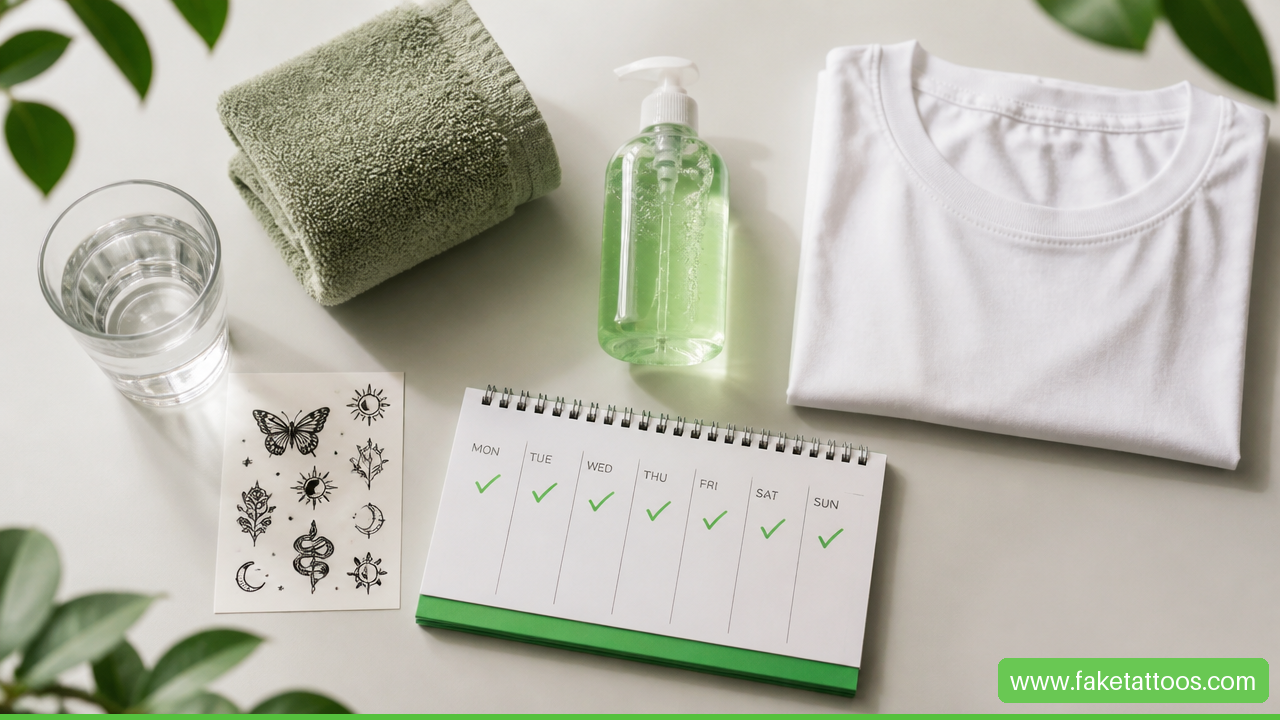
Shower gently
Use your hands and mild cleansing around the design instead of a loofah, exfoliating glove, rough washcloth, or body scrub. Avoid aiming a strong shower stream at the tattoo for a long time. When you finish, press a soft towel against the area to absorb water; do not rub back and forth.
Fake Tattoos’ care page recommends gentle cleansing, patting dry, avoiding excessive moisture, and reducing friction from clothing and accessories. 3 A short shower is generally a lower-stress choice than a long bath or hot-tub soak when preserving the design is important.
Keep oils and rubbing away from the image
The brand advises avoiding oils, lotions, and sunscreen directly over the tattoo because they may interfere with the adhesive or visible finish. 3 Do not skip sunscreen on exposed skin to preserve body art. Protect your skin according to the sunscreen label and apply carefully around the design where practical, knowing that rubbing or reapplication across the image may shorten its visible wear.
Choose soft, loose clothing during the first day when possible. Over the week, notice repeated contact from cuffs, waistbands, bra lines, watches, backpacks, socks, and shoes. Moving the design to a lower-contact area next time is usually more useful than adding a stronger coating.
Plan exercise and swimming realistically
Exercise is not automatically a problem. Sweat, damp fabric, and repeated movement are the bigger concerns. A tattoo on the outer upper arm may experience less contact during a walk than one under a compression sleeve, sports bra edge, waistband, or watchband. Change out of sweaty clothing and rinse gently if needed, then pat the area dry.
Swimming, salt water, chlorine, baths, and hot tubs create more prolonged moisture and often lead to extra towel rubbing. If your priority is reaching day seven, reduce long soaks and follow the specific product instructions. Water-resistant does not mean waterproof or scrub-proof. 1 3
Use a simple seven-day routine
- Application day: Clean and dry the skin, transfer the design carefully, let it air-dry, and protect it during the initial no-rub period.
- Days 1–2: Favor gentle showers, loose clothing, and minimal direct contact. Avoid exfoliation and long soaking.
- Days 3–4: Continue patting dry and check whether straps, cuffs, or exercise gear are wearing one edge down.
- Days 5–7: Expect some softening or fading. Reduce unnecessary rubbing, but do not pick at a lifting edge or sacrifice skin protection for a few extra hours of wear.
If the tattoo fades or starts peeling
A design that is incomplete immediately after transfer has an application problem. A design that fades gradually over several days is experiencing normal wear. In either case, aggressive repair usually creates a larger problem.
Do not pull at a loose edge, scrape the image, or glue it down with household adhesive. Do not apply hairspray, clear nail polish, liquid bandage, or an unknown sealant to skin. There is no universal coating that reliably makes every temporary tattoo last seven days, and an improvised product can alter the finish or irritate your skin.
If a design has become patchy, a clean, gentle removal and a fresh application may look better than trying to preserve a damaged section. For removal, follow the maker’s instructions. Fake Tattoos lists baby oil, rubbing alcohol, or makeup remover on a cotton pad, used gently from the edge inward; stop if your skin becomes uncomfortable. 2 3
Safety comes before maximum wear
Read the exact product directions and ingredient information before applying a temporary tattoo. Fake Tattoos recommends a small-area test, especially for people with a history of sensitive skin or allergies, and advises removing the tattoo and discontinuing use if redness, itching, or other irritation appears. 4 A small test can provide useful information, but it cannot guarantee that a later reaction will not occur.
The U.S. Food and Drug Administration has received reports of reactions to some decal, henna, and “black henna” temporary tattoos. FDA says henna is approved only as a hair dye, not for direct application to skin, and warns that products marketed as black henna may contain PPD, which can cause dangerous skin reactions. Avoid black henna and products with unclear ingredients. 5
If you notice burning, itching, swelling, blistering, a spreading rash, or other concerning discomfort, remove the tattoo according to its instructions and stop using it. Seek medical advice for severe or persistent symptoms. For broader guidance on testing products and responding to irritation, see the American Academy of Dermatology’s skin-product testing guidance. 6
Frequently asked questions
Can a normal water-transfer tattoo really last a full week?
It can under favorable conditions, but seven days is not guaranteed. Fake Tattoos describes its designs as water-resistant and lasting up to one week. Clean, dry application, lower-friction placement, and gentle aftercare give the design a better chance of remaining presentable through day seven. 1
Can I make a temporary tattoo last two weeks?
Do not treat two-week search results as a promise for Fake Tattoos water-transfer designs. Different product categories may advertise different timelines, but those claims depend on the exact formula, instructions, skin, placement, and definition of “last.” Fake Tattoos’ current first-party description is water-resistant wear up to one week, not a two-week guarantee. 1
Is a Fake Tattoos decal waterproof?
No. Fake Tattoos describes its decals as water-resistant, not waterproof. You can follow the product’s care guidance for normal washing, but scrubbing, oils, prolonged soaking, and friction can make the design fade faster. 1 3
Where should I put a temporary tattoo for the longest wear?
Start with a flatter, lower-friction area such as the outer upper arm, shoulder, or back. Hands and fingers are washed and rubbed more often, so they are less predictable for a full-week goal. Clothing, accessories, movement, and your own routine still determine the result. 1
Can I shower or exercise with a temporary tattoo?
Usually, follow the specific product instructions and keep the exposure gentle. Avoid scrubbing, direct high-pressure spray, rough towels, tight or rubbing clothing, and long soaks. Change out of sweaty clothing and pat the design dry instead of rubbing it. 3
Do I need a sealant to make a temporary tattoo last?
No universal sealant is required or proven to add a specific number of days across products. Follow the maker’s instructions and avoid hairspray, clear nail polish, household adhesive, liquid bandage, or unknown coatings on skin. Placement and careful aftercare are the more dependable levers.
Why did my tattoo peel after one shower?
The transfer may not have bonded evenly because of oil, lotion, damp skin, movement, insufficient contact, early peeling, or friction. A shower can reveal an application problem that started earlier. For the next application, focus on clean, dry skin, steady pressure, the stated transfer time, a slow peel, and the initial no-rub period.
Choose a design for your week
If you want a temporary tattoo for a trip, event, photos, or a week of trying a new look, begin with a design and placement that match your routine. Browse the Fake Tattoos collection, then check the instructions for the specific design before applying it.


