

Temporary tattoos that last about one week on active skin are possible, but no decal can promise the same result for every body or routine. Fake Tattoos describes its water-transfer designs as water-resistant and lasting up to one week, with wear varying by design, skin, placement, and aftercare. For a workout week, choose a lower-friction location, apply to clean and dry skin, and protect the design from repeated rubbing. Do not treat “waterproof” or “two weeks” as a guarantee.
What to expect from a temporary tattoo on active skin
“Active skin” means more than sweat. Daily workouts, showers, sunscreen, sports clothing, straps, towels, bending, and handwashing all create opportunities for a design to fade or lift. A tattoo can tolerate ordinary water and still lose crispness when soap, fabric, a watch, or a towel repeatedly rubs the same area.
Set the right goal: visible wear. A faint trace may remain after a week, but the design may no longer look sharp in photos or at an event. If the tattoo needs to look its best on a particular day, apply it early enough to confirm the placement, but close enough to the event that the design is still in its strongest visual window.
A third-party Yatatu guide reports roughly three to seven days for water-transfer tattoos under favorable conditions and says sweat, friction, and frequent water contact can shorten that range. That is a general seller’s estimate, not a controlled test or a promise for Fake Tattoos. Read the Yatatu guide for its product-specific context.
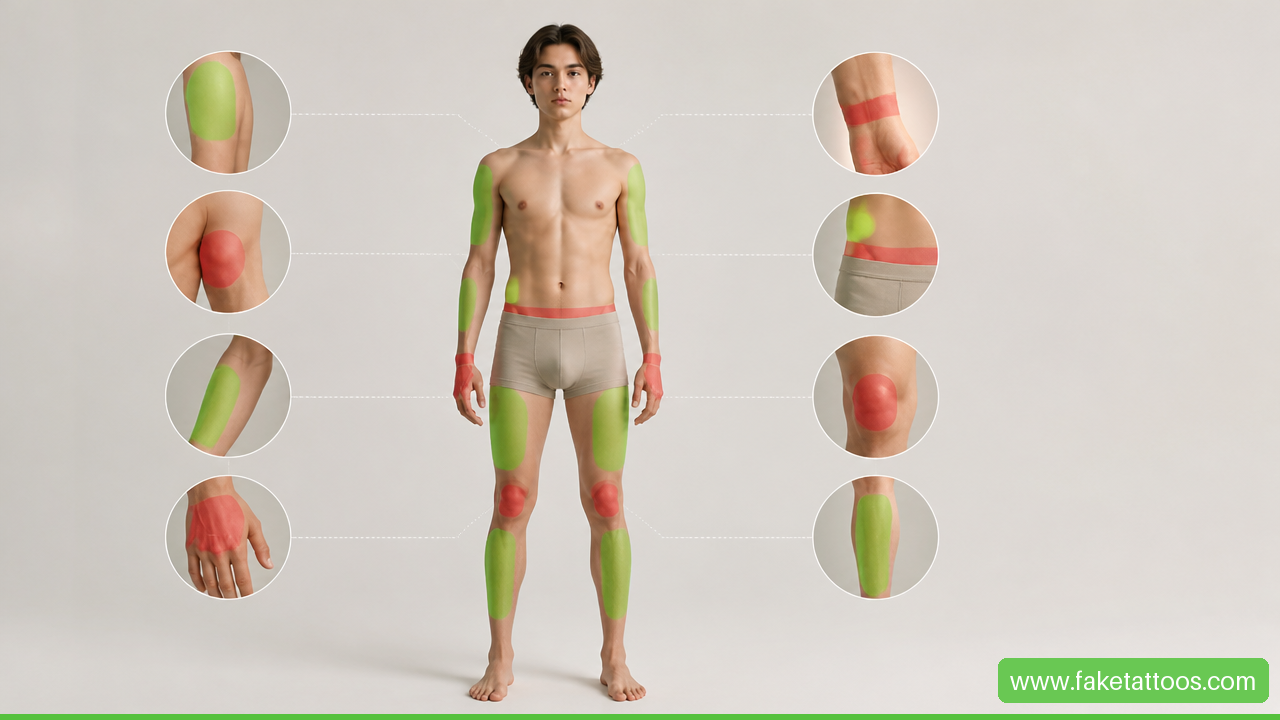
Choose placement before you choose the design
For an active week, placement is often the most useful durability decision. Favor a flat area that is not washed, bent, or covered by tight equipment throughout the day.
| Placement | Why it may work for an active week | Common risk |
|---|---|---|
| Outer upper arm or shoulder | Usually easier to keep away from handwashing and bending | Sleeve seams, backpack straps, or sleep friction |
| Outer forearm | Visible and often less exposed than the wrist | Desk edges, sleeves, and occasional washing |
| Upper back or chest | Can be protected by loose clothing | Sports bras, backpack straps, and sweat |
| Outer thigh | Broad, relatively flat surface | Leggings, cycling shorts, and waistbands |
| Calf | Less bending than a knee or ankle | Socks, footwear, and towel friction |
| Hand, fingers, wrist, ankle, or joint | Easy to see, but constantly moving or washed | Soap, sanitizer, watches, shoes, and bending |
Do not place a tattoo directly under a fitness tracker, brace, waistband, shoe collar, or strap if a full week of visible wear matters. A smaller design on a protected upper arm can perform better than a larger design on a wrist or hand, even when both are applied correctly.
Apply it for the best chance of seven-day wear
Start with the Fake Tattoos application guide and the instructions supplied with your design. The brand’s current guidance is to:
- Choose clean, dry, intact skin. Do not apply over cuts, rashes, sunburn, or existing irritation.
- Gently cleanse away sweat, oil, lotion, and other residue, then dry the area fully.
- Remove the clear film and place the design face-down.
- Press a damp cloth or sponge evenly over the entire backing, then lift one corner to check whether the design has transferred. Follow the instructions supplied with your specific sheet; timing can vary by product.
- Lift the backing slowly, check that the design has transferred, and let the tattoo air-dry without touching or rubbing it.
Avoid applying immediately after a workout, hot shower, or heavy sweating. Give the tattoo a calm start before tight clothing, exercise, or water exposure. A patchy transfer can be an application problem rather than proof that the tattoo’s wear time is poor.
Care for a tattoo through workouts and showers
The Fake Tattoos care instructions recommend avoiding contact and rubbing for at least 30 minutes after application, allowing the design to air-dry, cleansing gently, patting dry, and avoiding excessive friction and prolonged moisture. For an active routine:
- Choose a quick, gentle shower over prolonged soaking when appearance matters.
- Keep direct soap, body wash, scrubs, loofahs, and exfoliating tools off the design when practical.
- Pat the area dry instead of dragging a towel over it.
- Wear looser clothing around the tattoo when you can, especially during the first part of wear.
- Notice repeated contact from straps, seams, equipment, desks, bedding, or sports gear.
- Keep oils and lotions off the design when possible, because the brand says they can interfere with wear.
Do not skip sun protection to preserve a tattoo. If the area is exposed, protect your skin as appropriate and apply sunscreen gently, avoiding aggressive rubbing over the design. Reapplication, sweat, and friction may shorten the tattoo’s crisp appearance, but sun protection remains the priority.
What “water-resistant” means here
Water resistance is not the same as waterproof, rub-proof, or permanent. Fake Tattoos’ collection describes the designs as water-resistant and lasting up to a week. That means a design may remain through normal daily activity, but prolonged soaking, chlorine or salt water, soap, towels, oils, clothing, and repeated rubbing can still accelerate fading.
If you are searching for waterproof temporary tattoos or tattoos that last two weeks, treat those as generic search intents rather than promises about this product. Fake Tattoos’ water-transfer designs should be described accurately as water-resistant and up to one week, with results depending on the conditions above. Choose a different category only after checking that product’s current instructions, ingredients, and wear claim.
Safety notes for active skin
Temporary wear does not mean irritation is impossible. Follow the exact product directions, use the tattoo only on clean, dry, unbroken skin, and review the brand’s safety guidance. Fake Tattoos recommends a small patch test before a larger application, especially if you have a history of sensitivity or allergies. A patch test can reduce uncertainty, but it cannot guarantee that a longer or repeated wear period will cause no reaction.
The FDA reports adverse reactions to some decal, henna, and “black henna” temporary tattoos. It also states that henna is approved only as a hair dye, not for direct skin application, and warns that “black henna” may contain p-phenylenediamine (PPD), which can cause dangerous skin reactions. Read the FDA temporary-tattoo and black-henna fact sheet before choosing a stain or booth-applied product. Do not assume that “natural,” “brown,” or “waterproof” means risk-free.
The American Academy of Dermatology recommends testing new skin-care products on small areas and stopping if redness, itching, or swelling develops. Its home product-testing guidance is broader than a temporary-tattoo patch test, so follow the product’s own directions and use extra caution if your skin is reactive. Remove the tattoo if it burns, itches, swells, blisters, or causes a spreading rash. Seek medical advice if a concerning reaction persists or is severe.
Quick plan for a seven-day active week
- Pick the event and the stressors. List workouts, showers, swimming, clothing, straps, and handwashing.
- Choose a protected placement. Start with the outer upper arm, shoulder, upper back, outer thigh, or calf unless your clothing or equipment rubs there.
- Apply on calm, clean, dry skin. Follow the design’s own timing and let it air-dry.
- Protect visible quality. Reduce rubbing, scrubbing, prolonged soaking, and oily products over the design.
- Plan a backup. If the tattoo must look crisp for photos, carry a second design and do a small trial before the event rather than relying on a maximum wear claim.
Ready to choose a design? Browse Fake Tattoos’ water-resistant collection, then check the individual product instructions before applying.
Frequently asked questions
Can a temporary tattoo last about one week through daily workouts?
It can, especially in a lower-friction placement with careful application and aftercare, but it is not guaranteed. Sweat is only one factor; straps, clothing, showers, towels, soap, and repeated movement may shorten visible wear. Fake Tattoos describes its designs as water-resistant and lasting up to one week.
Where should I place a temporary tattoo for the best chance of seven-day wear?
Try the outer upper arm, shoulder, upper back, outer thigh, or calf if those spots are not rubbed by your clothing or equipment. Hands, fingers, wrists, ankles, knees, elbows, and areas under straps usually face more washing, bending, or friction.
Can I swim with a water-resistant temporary tattoo?
A water-resistant product may remain visible during limited swimming, but prolonged water exposure, chlorine, salt, swimwear, sand, and towel drying can reduce crispness. Check the product instructions, avoid rubbing the design, and do not interpret water resistance as a guarantee of waterproof or two-week wear.
Why did my tattoo fade after one shower?
Possible causes include incomplete transfer, applying over lotion or sweat, exposing a fresh design to water too soon, direct soap contact, towel rubbing, or a high-friction placement. Prepare clean, dry skin, follow the product’s application timing, and pat the area dry.
Is a longer-lasting temporary tattoo safe for sensitive skin?
Wear time does not prove skin compatibility. Check the product information, follow the package and brand directions, patch test when instructed, and avoid broken or irritated skin. Remove the tattoo at the first sign of discomfort and seek medical advice if symptoms persist or are severe.
How do I remove it if my skin becomes irritated?
Remove it promptly and gently using the product’s stated removal method. Fake Tattoos’ application guide lists baby oil, rubbing alcohol, or makeup remover on a cotton pad, followed by gentle rubbing; avoid aggressive scrubbing. Stop if removal itself irritates the skin.
Sources and references
- Fake Tattoos, How to Apply Temporary Tattoos
- Fake Tattoos, Care Instructions
- Fake Tattoos, Safety Policy
- Fake Tattoos, Fake Tattoos collection
- U.S. Food and Drug Administration, Temporary Tattoos, Henna/Mehndi, and “Black Henna”: Fact Sheet
- American Academy of Dermatology, How to test skin care products
- Yatatu, How long do temporary tattoos last? — third-party seller guidance, used only as an attributed benchmark
- Swagify, How long does a temporary tattoo last? — third-party guidance, not a verified Fake Tattoos product claim


