

Temporary tattoos that last two weeks with proper aftercare are possible—but usually only when the product is specifically made as a semi-permanent stain. Two weeks is a product-specific, best-case wear claim, not a universal result. It is also not a promise from Fake Tattoos: its water-transfer designs are described as water-resistant and lasting up to one week, with actual wear varying by design, skin, placement, and aftercare. 1
The practical answer is simple: choose the format first, then plan your application and care around that format. A stain-type product may develop over several hours and fade as the outer skin renews. A conventional water-transfer decal gives you an immediate image on the skin and is generally a shorter-wear option. No amount of aftercare can turn a one-week water-transfer decal into a guaranteed two-week or waterproof tattoo.
What “two weeks” means in practice
A two-week search usually refers to a semi-permanent temporary tattoo rather than a standard decal. For example, Tatteco’s current first-party FAQ says its own Two Week Tattoos transfer a transparent formula containing Genipa Americana extract, develop over up to 24 hours, and can last up to approximately two weeks. The same page says placement, skin chemistry, body temperature, washing, and exfoliation affect fading. Those are Tatteco’s claims for its own product category, not a performance guarantee for every temporary tattoo. 2
That distinction matters when you are planning for a vacation, photo shoot, or event:
- Developing stain: may be faint at first, deepen over hours, and remain recognizable for roughly two weeks under favorable conditions. The exact result varies.
- Water-transfer decal: transfers a visible design immediately and is often better for a short event or a look you want to remove easily.
- “Waterproof” wording: does not automatically mean two-week wear. Check the exact product’s instructions and current performance language instead of treating “waterproof” as a universal category.
If the design must look its sharpest on a specific date, apply a new product early enough to follow its stated development period—but do not apply it so early that the peak color has already passed. For an unfamiliar product, a small trial run is more reliable than assuming the headline duration describes the boldest appearance on day 14.
Can Fake Tattoos last two weeks?
Fake Tattoos’ current collection page describes its realistic water-transfer designs as lasting up to a week and being water-resistant, not waterproof. It also notes that upper-arm, shoulder, and back placements generally last longer than hands and fingers because those areas are washed and rubbed less often. 1
That makes Fake Tattoos a truthful choice for realistic, no-needle body art when you want up-to-a-week wear—not a two-week guarantee. If that fits your timeline, shop the Fake Tattoos collection and choose a design based on placement and occasion. If you specifically need a stain that may remain visible for about 14 days, compare products using their own current instructions, ingredient information, and qualified wear claims.
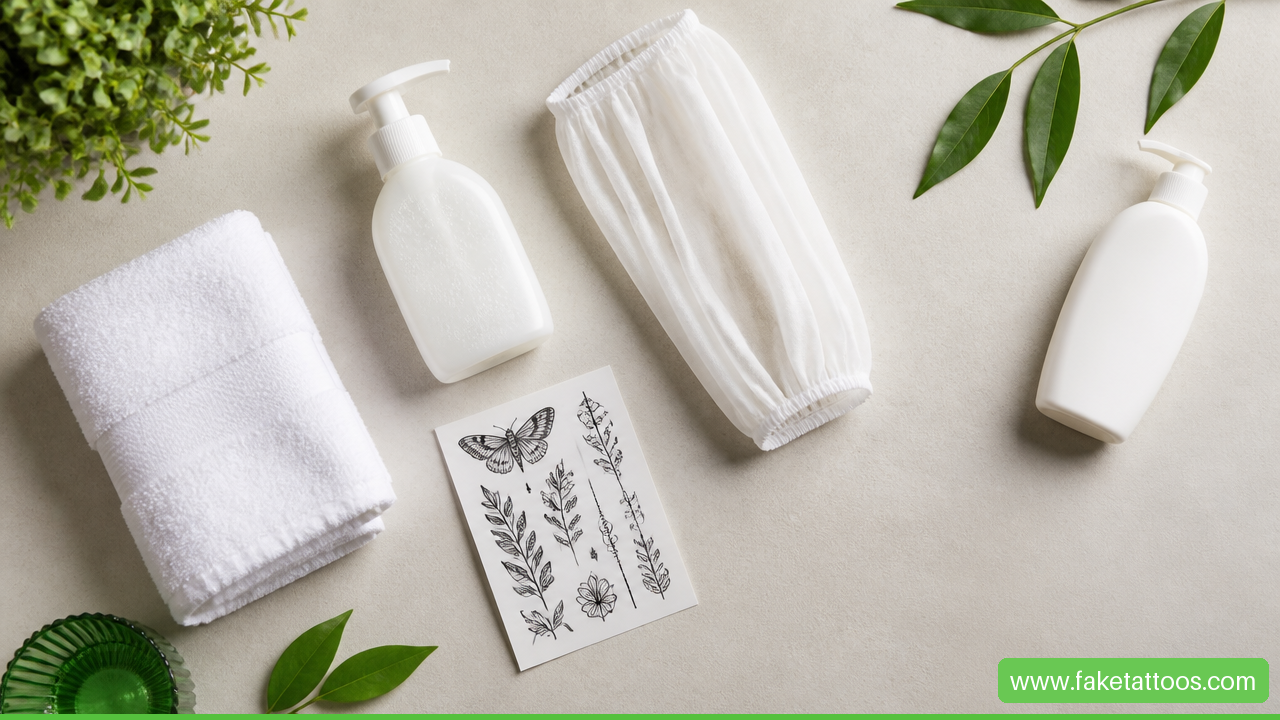
How to apply a two-week temporary tattoo for the best chance of lasting
Always follow the instructions supplied with the exact product. The following sequence is a practical checklist, not a replacement for package directions.
- Choose intact, calm skin. Do not apply over a cut, rash, sunburn, fresh shaving irritation, eczema flare, mole, or other broken or irritated area.
- Clean and dry the site. Remove sweat, lotion, sunscreen, oil, and residue. A clean, dry surface helps the design transfer or develop more evenly.
- Pick a lower-contact placement. The outer upper arm, shoulder blade, upper thigh, and outer calf may be easier to protect than fingers, palms, feet, waistbands, watch areas, or clothing seams. This is a practical placement pattern, not a guaranteed ranking.
- Apply exactly as directed. Dwell time, pressure, backing-paper steps, and whether the design should be nearly invisible at first vary by format. Fake Tattoos’ water-transfer guide says to place the design face-down, press a damp cloth over the backing, check the transfer, peel gently, and let it air-dry. 3
- Leave it alone while it sets. Avoid touching, rubbing, tight clothing, and accessories until the surface is dry and settled.
For a developing stain, do not judge the result immediately. Tatteco’s current instructions, for example, say its own product can continue developing for up to 24 hours. 2 That timing should not be copied onto a different brand or format without checking its directions.
Aftercare for longer wear
Aftercare cannot guarantee 14 days, but it can reduce avoidable fading.
During the first several hours
Use the exact initial-care window on the product label. Tatteco’s two-week instructions advise avoiding showering, swimming, and moisturizer on the area for at least eight hours, and note that development can continue for up to 24 hours. 2 Those instructions apply to that cited stain product; Fake Tattoos’ water-transfer products have their own application and care guidance.
During the initial window, keep the area dry, avoid heavy sweating if it will soak or rub the site, and choose loose clothing. Do not tightly wrap the tattoo in plastic or adhesive film unless the manufacturer specifically instructs you to do so.
Once the tattoo is set
- Wash gently with mild soap and water rather than scrubbing.
- Pat dry with a clean towel; repeated rubbing wears down surface designs.
- Avoid loofahs, body brushes, abrasive towels, scrubs, and exfoliating acids over the design.
- Limit prolonged soaking, pool time, and saltwater exposure if maximum wear matters.
- Reduce contact from watchbands, jewelry, backpack straps, tight sleeves, waistbands, and exercise equipment.
- Treat oils, rich balms, and vigorous lotion application as possible fading factors when the product instructions warn against them.
Fake Tattoos’ care page specifically advises gentle cleansing, patting dry, avoiding direct oils or lotions, reducing prolonged water exposure, and limiting friction. 4 Sun protection should not be skipped to preserve a design. If the area is exposed, protect your skin as appropriate and understand that sunscreen application and rubbing may shorten the tattoo’s visible wear.
When fading starts
Fading is usually gradual rather than an all-or-nothing deadline. Edges may soften, color may lighten, and high-contact sections may disappear first. Do not scrub harder to make uneven fading match. If you want to remove a design, use the product’s removal directions and stop if the skin becomes irritated.
Safety checks before you apply
Temporary does not mean automatically risk-free. The FDA says it has received reports of adverse reactions to some decal, henna, and black-henna temporary tattoos. It also explains that decal products differ: some transfer an image from a wet backing, while others use an adhesive backing that creates a partial or complete barrier. 6
Use these safeguards:
- Review the product’s ingredients and directions when available.
- Follow Fake Tattoos’ patch-test guidance if you are using one of its products, especially if you have a history of sensitivity or allergies. Its safety page recommends testing a small, discreet area and waiting 24 hours. 5
- Treat a patch test as a precaution, not a guarantee that a later or larger application cannot react. The American Academy of Dermatology notes that reactions can cause red, itchy, or swollen skin and recommends cautious testing for new skin-care products. 7
- Stop using the product and remove it gently if you notice itching, burning, redness, swelling, blistering, or other discomfort. Seek medical advice for severe, spreading, persistent, or worsening symptoms.
- Do not use black henna as a casual substitute for a two-week tattoo. The FDA says henna is approved only as a hair dye, not for direct skin application, and that blackening ingredients often include PPD, which can cause dangerous skin reactions. 6
A darker or faster stain is not proof of better quality. Choose a product with clear directions and ingredient information rather than relying on “natural,” “plant-based,” “non-toxic,” or “skin-friendly” wording alone.
FAQs
Is it realistic for a temporary tattoo to last 14 days?
It can be realistic for some semi-permanent stain products under favorable conditions, but the claim is not standardized. Expect gradual fading and changing color rather than the same crisp, bold design for all 14 days. A standard water-transfer decal may have a shorter wear window.
What is the longest-lasting type of temporary tattoo?
A semi-permanent stain is the format most directly associated with a roughly two-week target. A water-transfer decal is a better fit when you want an immediate image and easier removal. Compare the exact product’s instructions and qualified duration claim before buying.
Can I swim with a two-week temporary tattoo?
Swimming may be possible after the product’s initial care window, but prolonged pool or saltwater exposure, repeated washing, and rubbing can shorten wear. Follow the product instructions; do not assume that “two-week” means waterproof.
Can I make a Fake Tattoos design last two weeks?
Fake Tattoos currently describes its water-transfer designs as water-resistant and lasting up to one week, depending on design, skin, placement, and aftercare. Gentle application, lower-friction placement, and careful washing may help you reach the product’s best result, but they do not extend that claim into a guaranteed two weeks.
How do I remove one safely?
Use the product’s removal instructions. Fake Tattoos says its designs can be loosened with baby oil, rubbing alcohol, or a makeup-remover-soaked cotton pad, followed by gentle wiping rather than aggressive scrubbing. 3 If removal stings or leaves increasing redness, stop and let the skin settle.
Should I use black henna for a two-week look?
No. The FDA warns that black henna may contain PPD and has received reports of skin injuries linked to products marketed as henna and black henna. 6 Choose a clearly labeled temporary-tattoo product instead, and patch-test according to its instructions.


