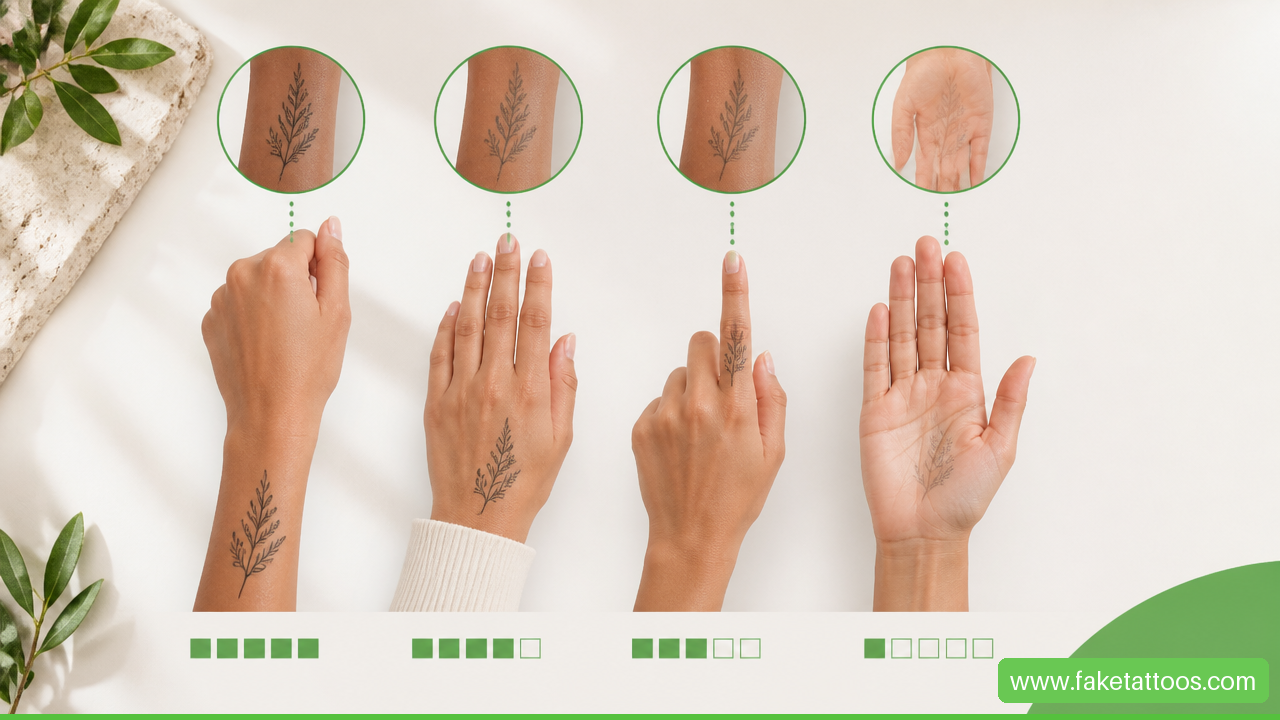

Yes, some water-resistant temporary tattoos can get through sweat and routine hand washing. The realistic goal is not a design that looks untouched after every wash. It is a transfer that stays recognizable when you choose a lower-friction placement, apply it to clean, dry skin, and reduce direct scrubbing and towel drag.
For Fake Tattoos water-transfer designs, the current product guidance is water-resistant wear up to one week, with results varying by design, skin, placement, and aftercare. That is not a waterproof promise, a fixed number of hand washes, or a two-week guarantee. If you need a design to look its best for a work shift, race, trip, or event, test one on the same body area before the deadline.
What Hand Washing and Sweat Actually Do
Water is only one part of the wear problem. Hand washing also adds soap, rubbing, bending, and drying. A towel can catch an edge that still looks fine while wet. Sweat can create another problem when it is wiped away with a sleeve, towel, glove, watchband, or piece of athletic equipment.
That is why a tattoo may tolerate water running over it but fade faster on the hand. The back of the hand receives repeated washing and contact. Fingers, knuckles, palms, and the spaces between fingers flex and touch surfaces constantly. An upper arm or outer forearm usually has fewer of those pressures.
Fake Tattoos’ care instructions recommend gentle cleansing, patting the area dry, and avoiding scrubbing, harsh chemicals, oils, and prolonged soaking. They also identify clothing, accessories, and repetitive activity as friction risks. Treat those instructions as care limits, not as a promise that every design will perform identically.
Water-resistant is not waterproof
“Waterproof temporary tattoo” is a common search phrase, but it can imply more than a seller has actually tested. The FDA explains that decal tattoos vary in construction and that some people have reported reactions to temporary tattoo products; a label or marketing term does not replace checking the product’s directions and ingredients. The practical question is how a specific transfer behaves under your specific routine.
For Fake Tattoos, the accurate description is water-resistant, with wear lasting up to a week depending on design, skin, placement, and care. Swimming, soaking, scrubbing, and repeated hand washing can shorten that window. If you are comparing products that advertise two-week wear, treat that as a separate, product-specific claim rather than assuming it applies to Fake Tattoos’ water-transfer designs.
Choose Placement Before You Choose the Design
When sweat and frequent washing are unavoidable, placement often matters more than the artwork. A detailed design on the outer forearm may stay clearer than a simple design on a finger because the forearm experiences less flexing and direct contact.
Better placements for active routines
- Upper arm or shoulder: Often a practical choice for workouts and daily activity when straps or tight clothing will not rub the area.
- Outer forearm: Visible and generally easier to protect than a hand, although sleeves, desks, and equipment can still create friction.
- Outer calf: Useful for some runners and outdoor activities, provided socks, boots, or compression gear do not rub the design.
- Upper chest or back: Lower hand-washing exposure, but clothing and straps still matter.
High-contact placements
- Back of the hand: More workable than a finger or palm for a short event, but expect water, soap, towels, door handles, and surfaces to affect wear.
- Fingers and knuckles: Frequent bending, gripping, and contact make crisp, long wear less predictable.
- Palms, fingertips, and between fingers: These areas are exposed to constant friction and moisture. Use them for a brief look or photo moment rather than a design that must stay sharp for days.
Before applying, check the full routine around the spot. A watch, bracelet, ring, glove, backpack strap, sports bra band, waistband, or uniform cuff can create more wear than sweat itself.
How to Apply a Temporary Tattoo for Better Wear
A weak transfer can look like a durability problem before the tattoo has faced any water. Follow the product-specific directions, and use Fake Tattoos’ application guide as the reference for its water-transfer designs.
- Start with clean, dry, unbroken skin. Gently remove dirt, oil, lotion, and moisturizer from the placement area, then dry it fully. Do not apply over cuts, rashes, or irritated skin.
- Cut out the design and remove the clear film. Place the tattoo face down so the image contacts the skin.
- Wet the backing thoroughly. Fake Tattoos’ current instructions call for a damp cloth or paper towel pressed firmly over the backing; check that the design has transferred before lifting the paper. Follow the directions supplied with your specific design.
- Peel slowly. If part of the image has not transferred, press the backing down and wet it again instead of dragging the paper across the skin.
- Let it dry before touching or covering it. Avoid stretching, rubbing, sweat, and clothing friction while the tattoo sets.
Do not add an unlabelled adhesive, sealant, or household coating to force a durability result. If you use any finishing product, it should be labelled for skin and compatible with the tattoo’s directions. A powder may change shine, but it is not a tested waterproof coating.
How to Protect It During Washing and Exercise
You should still wash your hands properly. The goal is to reduce unnecessary abrasion around the design, not to compromise hygiene.
When washing a hand tattoo, let water flow over the area and avoid deliberately scrubbing across the image. Clean the rest of the hand as needed, then press a clean towel lightly against the tattoo instead of dragging the towel over it. If the design is on the wrist or forearm, keep direct soap and rubbing away from it where practical.
After exercise, pat sweat away rather than wiping repeatedly across the tattoo. Choose a spot that stays clear of equipment, straps, gloves, and tight clothing. If sunscreen is needed on exposed skin, do not skip sun protection to preserve a decal; follow the product’s directions and understand that rubbing or reapplication may shorten wear.
Fake Tattoos’ care page says to avoid oils, lotions, and sunscreen directly over the tattoo, along with prolonged soaking. Its guidance also recommends patting the area dry and minimizing friction. These steps can improve the odds of a clean-looking transfer, but they cannot create a universal wear guarantee.
Test the Exact Routine Before an Important Day
A personal wear test is more useful than a generic “waterproof” label when your hands are washed often. Apply the same type and size of tattoo to the same placement several days before the event or work period.
Note the conditions that matter:
- How often you wash your hands or use sanitizer
- Whether soap is mild or strongly degreasing
- How much you sweat and whether you wipe it away
- Contact with towels, sleeves, jewelry, gloves, desks, or equipment
- Whether the design remains readable and flat at the edges
Set an honest pass standard. For example, you might need the design to remain recognizable after one workday, not to look exactly as fresh as it did after application. If the test fades too quickly, move the design to a lower-friction area or plan a fresh application rather than relying on a stronger claim.
Safety and Removal
Fake Tattoos’ safety guidance recommends a small test area for people with sensitive skin or a history of allergies. A patch test can provide useful information, but it cannot guarantee that a larger or longer-worn application will cause no reaction. The American Academy of Dermatology recommends cautious repeated testing for skin-care products and says to stop using a product and wash it off if redness, itching, or swelling develops.
Remove the tattoo if the skin becomes uncomfortable, itchy, red, swollen, or otherwise irritated. Use the product’s removal directions, such as baby oil, rubbing alcohol, or makeup remover on a cotton pad, and avoid aggressive scraping. Seek medical advice if symptoms are severe, persistent, or worsening. Do not apply a temporary tattoo to broken or already irritated skin.
The FDA has received reports of reactions to some decal temporary tattoos. It also warns that products sold as henna or “black henna” are different from water-transfer decals: henna is not FDA-approved for direct skin application, and black henna may contain PPD, which can cause dangerous skin reactions. Do not treat “natural,” “brown,” “black,” “hypoallergenic,” or “skin-friendly” as a guarantee for every product or every person.
Frequently Asked Questions
What temporary tattoos withstand sweat and frequent hand washing?
Look for a water-resistant product with clear application and care directions, then choose a lower-friction placement. For Fake Tattoos, the accurate expectation is water-resistant wear up to a week, varying by design, skin, placement, and aftercare. Hands and fingers usually face more wear than the upper arm, shoulder, forearm, chest, or calf.
Can a temporary tattoo survive hand washing?
It may stay recognizable through routine washing when applied correctly, but repeated soap, rubbing, towel drying, bending, and sanitizer use can fade it. There is no validated universal number of hand washes that every temporary tattoo can withstand.
Are water-resistant temporary tattoos sweat-resistant?
Water resistance does not remove the effect of sweat-wiping, clothing friction, straps, or exercise equipment. Choose a spot that avoids direct contact and pat sweat away instead of rubbing across the design.
Is the back of the hand better than a finger?
Usually, it offers a better chance of visible wear than a finger or palm because it has less gripping and direct contact. It is still a high-contact placement, so use it for shorter timing or test it before an important event.
Can I get two weeks from a Fake Tattoos water-transfer design?
Fake Tattoos currently describes its water-transfer designs as water-resistant and lasting up to a week, with results varying by design, skin, placement, and aftercare. Do not plan around a two-week guarantee. “Two-week” and “waterproof” searches are generic product intents; the truthful answer depends on the exact product and its current instructions.
What should I do if the edges start peeling?
Do not pull, tape down, or glue a lifted edge. Reduce rubbing and pat the area dry. If the design becomes patchy or the skin is irritated, remove it gently and use a lower-friction placement next time.
Where can I shop for a design?
Start with the Fake Tattoos collection, then check the individual product page for its current format, application directions, and wear guidance before choosing a placement.
Sources
- Fake Tattoos, How to Apply Temporary Tattoos.
- Fake Tattoos, Care Instructions.
- Fake Tattoos, Safety Policy.
- Fake Tattoos, Fake Tattoos collection.
- Fake Tattoos, Wolf Hour temporary tattoo product page.
- U.S. Food and Drug Administration, Temporary Tattoos, Henna/Mehndi, and “Black Henna”: Fact Sheet.
- U.S. Food and Drug Administration, Cosmetics Safety Q&A: Tattoos and Permanent Makeup.
- American Academy of Dermatology, How to Test Skin Care Products.